Showing posts with label Few Paintings. Show all posts

27 June 2015

A tribute to Dominique Jado

Who could expect after three hours driving on a mud road through the rain forest to find a large painted fresco representing many of the prestigious French Grand crus? It is however what can be seen on the walls of the restaurant at the Auberge des chutes Voltaire mentioned in an earlier post. This four panel fresco deserves a post on its own. Dominique Jado who died two years ago, completed this work in 1994. Not much is known about this artist. He lived in French Guyana where he signed few works; another of his frescos, "Cayenne reminiscence",  can be seen at the Café des Palmistes. We simply learnt from the inn owner that D. Jado visited the inn several times and he enjoyed wine :-). Let's have a short visit of this epicurean and philosophical composition.

Starting from the left, the first panel represents a group of friends around a table in an inn. They are enjoying themselves, celebrating, eating and toasting in a noisy atmosphere. This subject is in contrast with the quiet remote place of the Chute Voltaire surrounded in each direction by millions of acres of  rain forest. This panel is so dense that it is not possible to get into much details here. Let's just stress that there are many costly bottles of wine on the table and the labels are quiet exact and precise on the year. One mistake can however be noticed by connoisseurs: The Chateau d'Yquem, a sweet Bordeaux, is not a red but a white wine; it is also not sure that the "Chateau Voltaire" ever existed but these are all evident touches of humour which fit perfectly with the merry atmosphere around this table. For more details and close-up see the supplement below.
Panel #1
By opposition to panel#1, the second and the third panels make a dyptic representing with a certain nostalgia the "home sweet home" somewhere in Europe.
Panel#2: A woman is spinning the yarn while, in the other room, the maid is setting the table. The large stones of the wall, the heavy furniture and the headdress of the two women would suggest the interior of a rural house (in Brittany?)…A child memory of the parent's house at the native place of the artist?
Panel#2
Panel#3: A old man is meditating seated opposite to the fire place. A white cat lays on the floor. The few cooking objects around are well in place. This cosy corner gives the impression of loneliness, serenity and wisdom. As time goes by, the old man is contemplating his own life...
Panel#3
The fourth and last panel is again representing a socialising scene in a café. The card players remind the scene of an anthological piece: "La partie de carte" from Marius, one of the most famous Macel Pagnol's theater play… A caricature on how French society works :-)
Panel#4a (left)
On the other corner of the Café's room (right side of panel#4), the Pastis jug stands on the bar…A man and a woman are discussing behind the smoke of a cigarette. Are we in le Vieux-Port in Marseille? Likely not because there is no terrace next to the room. This panel could also be seen as the inner atmosphere of a Parisian café where the artist used to go when he was still living in Europe.
Panel#4b (right)
Many questions remain but each one will certainly find his/her "own way" to read  these wall paintings. The talent does not sit always in musea!

10 June 2015

June 10th, Abolitionism day

Today is the celebration of abolitionism in French Guiana. This painting of Marie-Gillemine Benoist exibited in the Salon de Paris (1800), six years after the slavery abolition by the Convention, is considered as a symbol for women's emancipation and black people rights (source wikipedia). This work which has been acquired by Le Louvre Museum is presented here as a contribution to the 10th of June celebration.
Marie-Gillemine Benoist (1768-1826)
Portrait d' une femme noire - Original title Portrait d'une Négresse, 1800, Musée du Louvre

There are few key entries to "read" this work and to eventually get an overall interpretation: the biography of M.-G. Benoist, the problems she encountered as a woman to study in men's atelier under the Ancien Régime, the respective influences of Louise Elisabeth Vigée-Lebrun and Jacques-Louis David on her painting style, the identity of the portrayed woman, … they are widely detailed on the web or in museum guides not be repeated here.
En passant, few years before, Olympe de Gouges (1748-1793), beheaded during the French Revolution, was also a significant figure fighting for women rights and abolitionism. She should be mentioned as well.

06 June 2015

Exhibition in Musée de l' Espace

On 05/06 in Kourou, the Musée de l'Espace located at the entrance of the Centre Spatial Guyanais opened a temporary exhibition to the public called "Les pieds dans l'art" (Feet in art). Many local schools were invited to exhibit works realised during the year by the pupils on this subject. Nothing to do with space but art and engineering are not antagonistic domains and young creative artists may become tomorrow innovative engineers.
We are pleased to offer to the readers of this blog a "florilege" of this colorful exhibition which also gives a flavor of the richness and talents found French Guiana...
"Les pieds dans l'air", Ecole Solange Patient classes CE2 CM1,
exhibited at the entrance of the Musée de l'Espace

"Couleurs pieds" (détail), Ecole maternelle Raymon Cresson

Le paradis des pieds (detail), Ecole élémentaire Roland Lucile

Mes pas en arc-en-ciel, Ecole maternelle Solange Patient

"La famile claquette" ou pieds de nez (detail), Ecole maternelle SABA

"Le Zoo des Godillots', Cours préparatoire et Cours élémentaire 1, Ecole SABA

12 May 2015

Vernissage

 In the MSG-3 blog post, "spin me a colourful day", we already talked about Shunyam. This Dutch artist enriched the MSG programme since the very beginning with joyful paintings, posters, stickers, pads... Her pictural motives were used on many Public Relations (PR) items during the four campaigns. Today we invite readers of this blog to a premiere: A dedicated exhibition showing for the first time, next to each other, all the paintings she specially made for each MSG spacecraft.

  • MSG-1 - In this first painting, a satellite floats in a light purple sky. On the coast, cut along a diagonal line, palm trees and flowers stand up on the foreground looking at this funny bird. The figurative composition obviously evokes the French Guyana coast with its exotic flora. The simplicity of the drawing, the balance and harmony between the various objects, the warm colours contribute to the happy atmosphere of this painting.

MSG-1 Launch campaign painting (120x120) and logo, 2002
ESA
  • MSG-2 - This second painting is the pendant of the first one as it is based on the same concept (diagonal line between land and sea, two dominant yellow and blue colors…), the spacecraft is playing this time with the local fauna: two colored exotic birds, a large turtle carried by a wave and few fishes. Again, the staging of this merry company around the spinning satellite gives the impression of  harmony and balance in a dynamic context.

MSG-2 Launch campaign painting (120x120)/logo, 2005
Private collection
  • MSG-3 - The seven years between MSG-2 and MSG-3 launches may explain the difference of the third composition with the two preceding ones. This painting is structured along the median lines of the canvas (water level and split of the banks). Two large opposite toucans  encourage with their open beaks the spinning spacecraft. Even the fishes, pulling their heads out of the water surface, seem to enjoy to the show. The three blue Morpho butterflies, Palm trees, Red gingers, Heliconia flowers remind the colourful peculiarities of the French Guyana coastal landscapes with an evident touch of reality.

MSG-3 Launch campaign painting (120x120)/logo, 2012
ESA
  • MSG-4 - This fourth painting introduces new comers: crocodiles and lizards. They are running here and there in a a kind of excitation mode. But is this hectic movement caused by joy or fear? The show takes place on the land. Large leaves, flowers, large animals, butterflies positioned in all directions render this composition very dense. This is amplified by the lack of perspective of the drawing. By contrast to this "Earth chaos", the upper part of the painting  is filled with a light blue area giving an impression of quietness. In this peaceful sky, MSG-4 floats alone over this agitated scenery. It is almost gone... and already envisioned its new horizons. It is time now to greet for the last time its Guyanese friends.

MSG-4 Launch campaign painting (120x120)/logo, 2014
ESA
  •  Bonus - This MSG painting made in 2014 was judged too abstract by management for becoming a logo to illustrate further PR items. Indeed, realistic echoes of French Guiana have completely disappeared here. Instead, a multiple interaction of a simplified shapes (cylinders and circles), produces a surprising texture which may trigger multiple interpretations: The beginning of an old super 8 amateur movie, Professor Calculus' experiment on a Colour TV set in Marlinspike Hall, a rain of stars, the bubbles of "space champagne", the forever production of full (Earth) disk images, a new theory of colours?…whatsoever, we leave readers' imagination to see this Shunyam's last MSG work their own way!
MSG and the Alph-art ? (120x120), 2014
ESA


08 May 2015

From Dürer to Darwin: exotic fauna in drawings

Before the photography era, drawing, painting, etching,... were among the only media to disseminate images from the "new world". Such illustrations from the Renaissance up to the second half of the XIXth century are preserved today in Musea and/or university libraries. The striking resemblance of these works with reality just reflects the very high drawing skills of the artists. This explains also why some of them were patronized to support long-range scientific expeditions. To this respect, graphic arts became progressively an efficient tool of botanical, geological and zoological development. The very few examples below try to show the talent of these artists and the different goals they wanted to reach. Some of the exotic animals below can still be observed in French Guiana during the MSG-4 Launch Campaign...
Albrecht Dürer (1471-1528)
Rhinoceros, 1515... first representation of such an animal in Europe (though Dürer never saw this animal located in Portugal). This Rhinoceros died in a shipwreck in the Mediterranean sea in 1516 while it was sent as a present by the King of Portugal to the Pope Leo X!

Albert Eckhout (ca 1610-1655)
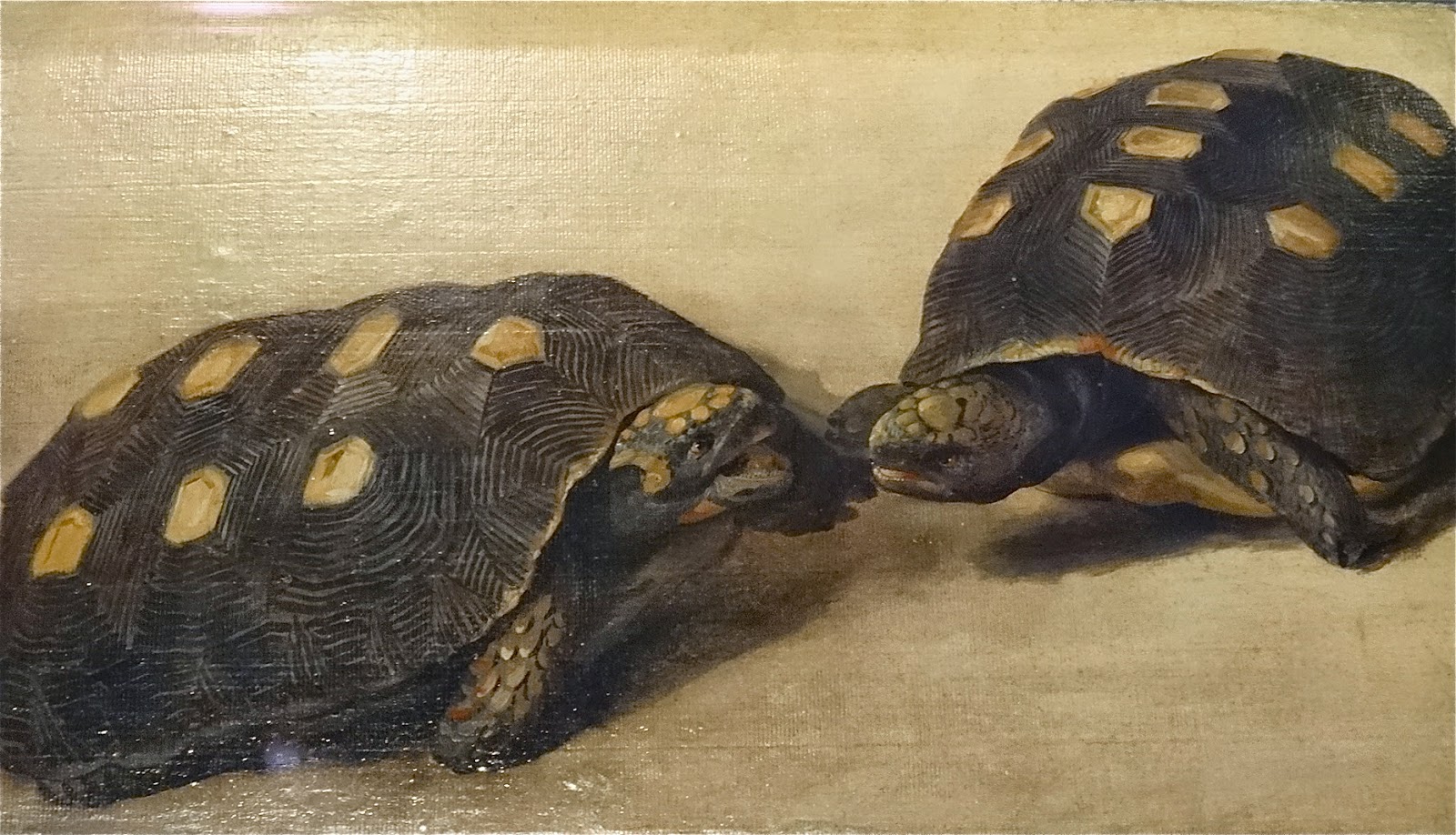
Study of two Brazilian (giant) turtles, ca 1640, Mauritshuis, Den Haag. The comparison with pictures made in French Guiana during MSG-3 launch campaign is striking!

Also to be seen  in the Mauritshuis, a painting called the Garden of Eden and the fall of the man, ca 1615. This work was a join effort of two major artists of the time, Jan Brueghel I (1568-1625) for representing the animals and Peter Paul Rubens (1577-1640) for Adam and Eva. A detail of this painting shows various birds sitting in branches including exotic ones...

Pieter Boel (1622-1674), was also an expert in animal studies and postures.
Above: Study of a parrot (ara arauna), Le Louvre
Right: Study of 2 parrots (ara chloroptère and ara arauna), Le Louvre
These species of Red and green macaws can be observed in French Guiana.

Frans Post (1612-1680) was already mentioned in a previous post.
View of Olinda, Brazil (detail), 1662, Rijksmuseum, Amsterdam
From left to right:  Anteater, Ape, Cingulata

Melchior d'Hondecoeter (1635-1690),
The Menagerie, ca 1690, Rijksmusuem

Jean Baptispte Oudry (1686-1755)
From left to right: Demoiselle crane, Guianan Toucanet, Tufted crane, 1745, Schwerin, Galerie Alte & Neue Master
In the same museum in Schwerin, one should not miss the Jean Baptiste Oudry's famous Rhinoceros (Portrait of Clara in Paris, 1749). This female Rhino was toured in Europe as a star and had a less tragic fate than the Dürer's one...

Charles Darwin (1809-1882) used these sketches (and much others)  to elaborate his theory of the evolution (On the origin of Species,1859).
Darwin's finches, 1845
credit wikipedia

03 May 2015

A Postcard from the Dutch Goden Age

The beginning of the Columbus era (>1492) started to unveil various aspects of the South American continent to the West. It is generally admitted that the first elaborated landscapes of these remote lands known in Europe are attributed to Frans Post (1612-1680) a Dutch painter who lived in Brazil between 1637 and 1644. He was commissioned by Johan Moritz von Nassau-Siegen, Dutch Governor in Brazil.
The Dutch Brazil (1630-1654) was at that time a large area located along the most Eastern part of Brazil. This is different from Suriname, a former Dutch colony established as from 1667, which is located at a slightly higher latitude. Suriname has a border with French Guiana.
Dutch Brasil, Credit Wikipedia
Despite different locations, the coastal and land views of the Dutch Brazil painted by Frans Post might show some resemblances with the Surinam and French Guyana ones we see today. All had and still have numerous wide muddy rivers meandering up the Atlantic ocean and huge areas of rain forest with a rich equatorial/tropical fauna and flora. 
The picture below, dated 1639, depicts a scenery along the San Francisco river located in the Alagoas. Frans Post surely wanted to impress his audience with the Cabiaï on the foreground not known in Europe. If the large treelike cactus evokes an exotic country, the low horizon line and the blue and grey woolly sky could remind a Dutch atmosphere from Jacob Ruysdael's or van Goyen's paintings.
Rio Sao Francisco and the Fort Maurice, with a Cabiaï in the foreground, 1639, Le Louvre
Frans Post completed only very few (6) out of the 140 paintings attributed to him while he was in Brazil. Curiously, most of the ones he made in Brazil are in Le Louvre (Paris) because they were presented (and sold?) by Jan Moritz van Nassau to Louis XIV. But still one of these "originals" can be admired in the famous Moritz' house in The Hague which is known today as the Mauritshuis, one of the most beautiful Dutch museum (see painting below).
View of the Itamaracá, island in brazil, 1637, Mauritshuis, Den Haag
Credit Wikipedia
In the "Brazilian" landscapes he made once back in Haarlem, Frans Post was working from memories and from the sketches he brought back with him. One can notice that he slightly changed style, using brighter colours, showing more imagination or fantasy. This produced baroque or even romantic effects as proved by the painting below:
Paulo Alfonso falls, 1649, Sao Paulo Museum of Art, 
Credit Wikipedia
In the same period, we should also not forget to mention Albert Eckhout (ca 1610-1665) who painted few local portraits and  still lifes from the Dutch Brazil. Some of his paintings are exposed in the Amsterdam  Rijksmuseum and in the Maurithuis (e.g. Study of two brazilian tortoises, ca 1640).
Last but not least, Dirk Valkenburg (1675-1721), two generation later, spent some years in Suriname where he made few paintings in the early 1700, but at that time the Dutch Brazil was over…

01 May 2015

The black lion tamarin and the mysterious man

During the MSG-3 Launch campaign, we had a chance to observe a Red Handed Tamarin in action! (no comment post dated June 10th, 2012).
Apparently this type of small apes were known in Europe as early as the XVIth century as proven by the detail of the painting below.
Jan Cornelisz Vermeyen (Beverwijk ca 1500 - Brussels 1559),
Portrait of a man (detail 1), Museum Wallraf Richartz, Köln
The species represented next to the portrait seems to be a Black Lion Tamamarin (Leontopitheus Chysopygus), a small ape living in Brasil.
Coming back to the painting, one can wonder why this notable person wanted to be painted with a little ape and what was the meaning? Before investigating further, one can notice another detail that may be as odd as the first one: a little dog with its head and legs getting out of the fur collar coat. Was the guy simply a pet lover? No - this would be too simple. Had he connections with the Dutch outposts in South America? The Dutch Brazil will come roughly 100 years later…
Jan Cornelisz Vermeyen (Beverwijk ca 1500 - Brussels 1559),
Portrait of a man (detail 2), Museum Wallraf Richartz, Köln
The full painting shows a man with a long face, his head covered with a flat hat. The guy is looking at us in a rather authoritative way with one finger pointing upwards. Would his clothing be characteristic of a dedicated corporation or job? Could the decoration on his chest provide any further clue? Certainly but expert support would be needed on this matter to be conclusive. About the two animals, the dog and the ape, we can say that there are frequently represented in painting from the Renaissance up to the XXth century. They are likely used here as symbols to emphasize the way this character wants to appear vis a vis the others.
Jan Cornelisz Vermeyen (Beverwijk ca 1500 - Brussels 1559),
Portrait of a man, Museum Wallraf Richartz, Köln
If the dog in many civilisations is the symbol of the "guide" to pass borders (e.g. Egypt), it has also the meaning of protection (watch dog). The ape, may have several meaning as well depending on the context: witty, amusing, robbery... This Dutch or Flemish wealthy bourgeois who was portrayed by J. C. Vermeyen ca 1530 seems here to  tell us with not much humor:
-Be careful when you make business with me, I am not a nut but an important man.
There are are certainly other interpretations, Any other ideas?

Note: Any resemblance with existing shadow experts is purely coincidental :-)